How do AI video interview tools compare for screening large applicant volumes?
magine receiving 1,000 applications for 20 open positions. You run them through an AI video interview tool and 40 candidates make the shortlist. A productive week. Now another recruiter, hiring for the exact same roles, runs the same 1,000 applicants through a different platform. Their shortlist barely overlaps with yours. So who found the better candidates? Most AI video interview platforms promise to make high-volume hiring easier. Far fewer explain how they decide who makes the cut.
A side-by-side look at how AI video interview platforms evaluate candidates, where automated screening falls short, and what to check before you pick one.
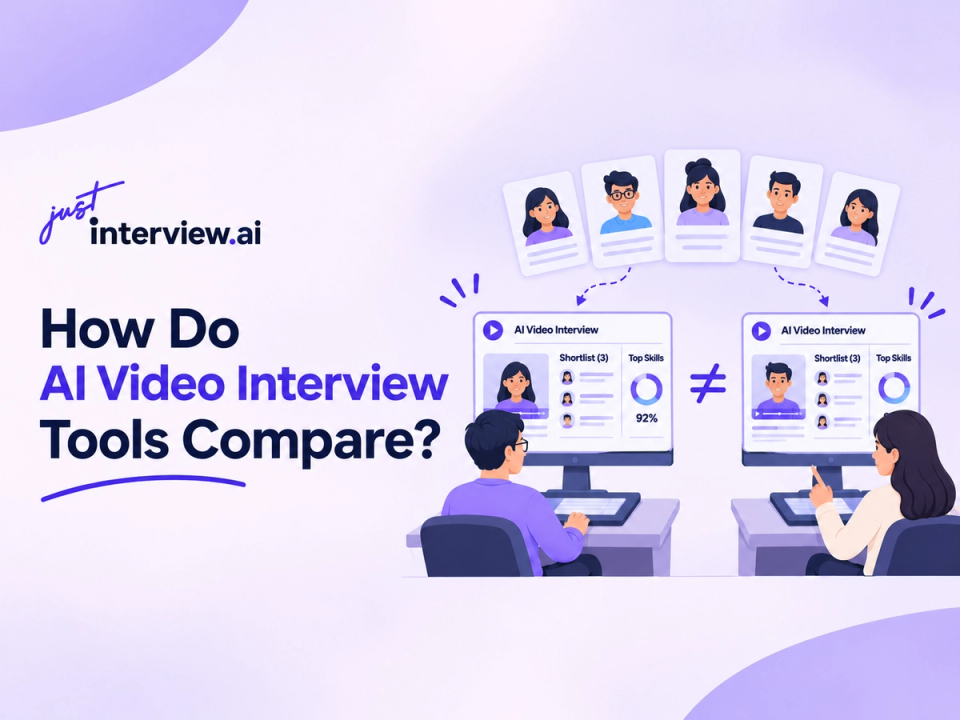
Say you're hiring 20 customer support executives. By Friday there are 1,000 applications. Some candidates have the right experience, some have transferable skills, and some applied because the job title sounded vaguely familiar.
Both tools in our example handled the volume without trouble. Almost every AI video interview tool can. They differ in what they look for, and in how much of that they show you.
That's why "how many candidates can it screen?" is the wrong first question. Ask what each tool rewards, because that decides who you end up meeting.
Asynchronous video interviews vs live AI interviews
"AI video interview" covers a wide range of products.
At one end is one-way video interview software. Candidates record answers to a fixed set of questions on their own time, and recruiters watch the recordings later. An asynchronous video interview solves scheduling well. It doesn't solve evaluation: 500 recordings are still 500 recordings someone has to watch.
In the middle are tools that add transcripts and AI scoring to those recordings. At the other end are live AI interviewers that hold a two-way conversation and ask follow-up questions based on what the candidate just said. We cover that format in more detail in Best AI Interview Platforms for 24/7 Hiring.
The format changes the result. Picture two candidates for a customer success role. One gives polished, confident answers. The other is slower to explain but clearly understands how to calm down an angry customer. A tool that weighs delivery picks the first. A tool that weighs substance against the role picks the second.
Five things to compare before choosing an AI video interview platform
1. Does the interview change with the role?
A developer, a sales executive and a support agent shouldn't get the same template. Look for questions built from the job description, with the skills and experience that role actually needs.
2. Does it evaluate answers, or only collect videos?
Check whether responses are scored against defined competencies, and whether you get a summary with evidence. A dashboard of 500 recordings and a ranked list with reasons are very different things to work from.
3. Can it test skills, not just talk about them?
A candidate can describe how they'd debug code without being able to do it. For technical roles, look for coding rounds or vibe coding interviews alongside the video.
4. Can you see why someone was shortlisted?
"They scored 87%" won't convince a hiring manager. You need the answers, the skills shown and the gaps behind the number. (More on that in Two Candidates Get the Same AI Interview Score.)
5. Will good candidates actually finish it?
Candidates are judging you too. Clear instructions, a 15 to 20 minute interview, mobile support and a word on what happens next all lift completion rates. Screening 1,000 people means little if the best ones drop out halfway.
How the main types of AI video interview tools compare
The table below compares the common tool types on those five points. Use it as a starting checklist for demos, not a final verdict.
| Tool type | Customisation | Evaluation | Skills testing | Transparency | Candidate experience |
|---|---|---|---|---|---|
| One-way video interview software | Fixed question set per job | Recruiters watch recordings; little or no scoring | Spoken answers only | You see the video, nothing more | Record any time; no follow-ups |
| HireVue | Large question libraries and enterprise templates | AI-assisted scoring against job competencies | Assessments available alongside video | Ask in the demo how scores are explained | On-demand video, built for enterprise scale |
| Live AI voice screeners | Role-specific scripts | Transcripts and summaries | Conversation only | Varies by vendor | Real-time conversation with follow-ups |
| JustInterview.ai | Questions generated from each job description | Scored report with per-skill breakdown, transcript and recording | Coding, MCQ and vibe coding assessments in the same flow | Recruiters see the evidence behind every score | Voice or video interview with adaptive follow-ups, any time |
If you're looking for a HireVue alternative, the gap to check is usually setup time and price for mid-sized teams, plus how easily you can add technical rounds. Our JustInterview.ai vs HireVue comparison goes through it point by point.
Test them on the same role before you decide
The fairest comparison is a small pilot. Take one role you've already filled and 50 past applicants whose outcomes you know. Run them through each shortlisted tool with the same criteria.
Then check:
- Did the tools assess the same job-related skills?
- Were similar answers scored the same way?
- Which shortlist included the people who went on to do well?
- How long did it take your team to understand each tool's results?
A different shortlist doesn't automatically make one tool worse. The pilot tells you which one gives your recruiters better information for decisions they already make.
A shortlist is where hiring starts
Back to those 1,000 applications. The goal was never 40 names by Friday. It was 20 people who can do the job.
A polished answer isn't always a strong one, and the candidate who didn't stand out on first pass may still be sitting in the pile. Pick the AI video interview tool that shows your recruiters enough to find them.
Frequently asked questions
Is one-way video interview software the same as an AI video interview tool?
Not always. Many one-way tools only record and store answers. AI video interview tools add evaluation, such as scoring against competencies, summaries and per-skill reports.
Can AI video interview tools pick the best candidates on their own?
They can narrow a large pool and surface evidence, but a high score doesn't guarantee a great hire. Recruiters should review the reasoning behind each shortlist.
How should I compare AI video interview tools for high-volume hiring?
Compare role customisation, how answers are evaluated, skills testing, how clearly scores are explained, and candidate completion rates. Then pilot two or three tools on the same past role.
What is an AI video interview?
An AI video interview is a first-round interview where candidates answer questions on video or voice, and AI helps transcribe, summarise and score the answers. Some tools record fixed questions; others hold a live conversation with follow-ups.
Key takeaways
- • Almost every AI video interview tool can handle 1,000 applicants. They differ in what they reward
- • Asynchronous video interviews fix scheduling; evaluation is a separate question.
- • Compare tools on customisation, evaluation, skills testing, transparency and candidate experience.
- • Pilot tools on a role you've already filled to see whose shortlist matches your real hires.
Based on JIA internal platform data across 5,000+ candidates.
Get started
1,000 applications. One shortlist you can explain.
JustInterview.ai ranks resumes, runs AI video interviews with follow-up questions and adds coding or skills tests in the same flow, so every shortlisted candidate comes with evidence. Free for 14 days, no card needed.